
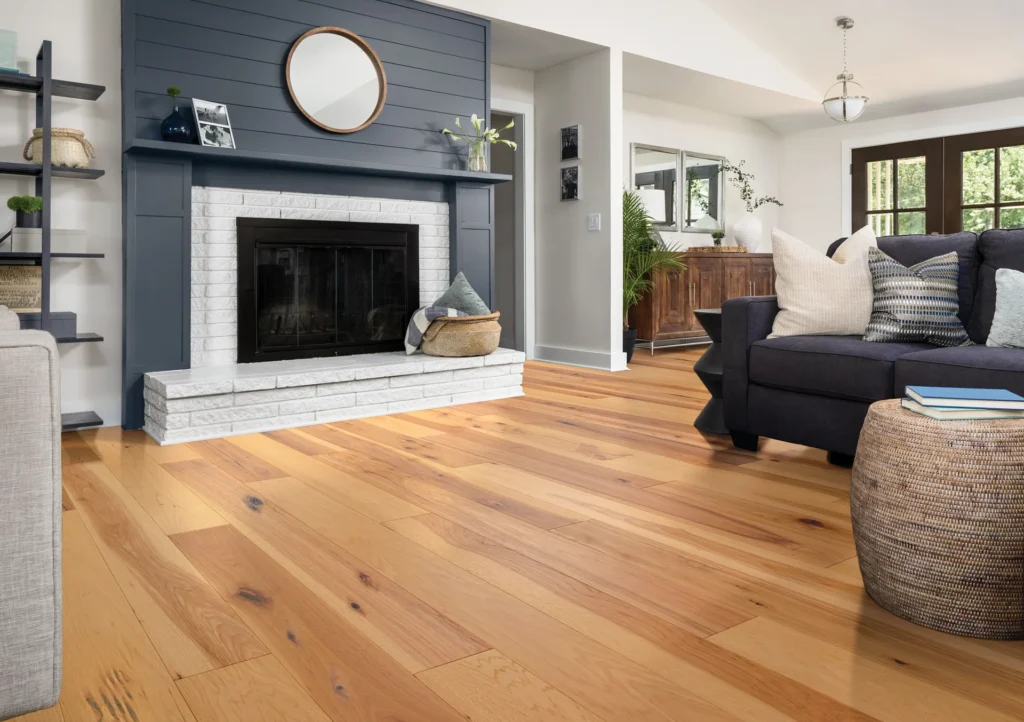

You cross the kitchen in socks and one spot near the fridge goes thunk. Two steps later, a plank by the back door gives a tiny snap. Neither sound was there in the showroom. Now you wonder if the new floor is failing.
Most of the time, it is not. But a vinyl plank floor talks, and each noise points to a different cause. So instead of starting with causes, start with your ears. Name the sound first. The fix follows from that.
Four sounds, four different stories
Many vinyl plank floors are floating floors. That means the planks lock to each other, not to the subfloor below. They rest on top and can shift a tiny bit as one big sheet. That small freedom is normal. It is also where most of the noise comes from.
| What you hear | What is likely going on | How worried to be |
|---|---|---|
| A dull, drum-like hollow thud | The plank spans a dip in the subfloor, so there is air under it | Low if it is faint and steady; higher if the plank flexes or the area grows |
| A sharp click or tick | Locking edges rubbing, or a joint that did not fully lock | Watch it; get it checked if joints start to open or rise |
| A creak or groan | Often the wood subfloor or a loose board under the planks | Worth a look, since the source may sit below the vinyl |
| A crackle or crunch | Grit or debris trapped under a plank | Have it checked; grit can wear the plank and edges over time |
A mild hollow tone across a whole room is common with floating floors. Planks sit over a thin underlayment, not glued down, so they sound a bit lighter than tile. That alone is not a defect. What matters is a sound that is loud, local, or changing.
What usually sits behind the noise
- Low spots or humps in the subfloor. A plank bridges the dip and bounces when you step on it.
- Debris left under the planks. A small chip or screw head can lift a plank and make it rock.
- Locking edges that were damaged or not pushed fully together during the install.
- Underlayment that is too soft or squishy for the product, letting joints flex with every step.
- Expansion space that is too tight. Planks press against a wall, door frame, or pipe and bind.
- Heavy fixed items like cabinets or a kitchen island set on top of a floating floor, pinning it so the rest cannot move freely.
Which underlayment is allowed, and how flat the subfloor must be, are set by each plank maker. Those rules live in the product's installation guide and warranty. Check your own product rather than any general number you read online.
Homework: map the sound for one week
Before anyone pulls up a plank, spend a few days tracking the noise. This short routine turns a vague complaint into clues an installer can use.
- Where: put a small piece of painter's tape on each noisy spot. Note if spots cluster near a wall, doorway, cabinet, or vent.
- What: write down the type of sound from the table above. Hollow, click, creak, or crackle.
- When: does it happen every step, only in the morning, or only on hot or rainy days?
- Who: does it sound under light steps too, or only with heavier weight?
- Change: walk the same path each day. Is the noise the same, louder, or spreading?
South Jersey homes swing from dry, heated winter air to humid summers. A click that only shows up in one season may be the floor reacting to that shift. A click that grows every week, no matter the weather, deserves a closer look.
Quiet quirk or real problem?
A faint, even hollowness that never changes is usually something you can live with. The planks are locked, flat, and doing their job. Many people find it fades into the background once they know it is harmless.
Call an installer when the noise is getting worse, when joints separate or peak upward, when a plank lifts or rocks, or when you smell must or suspect water below. Those signs point past a sound issue. If you also see gaps, our guide on why vinyl plank floors separate covers that side.
How these spots usually get fixed
The fix depends on what the map shows. A single hollow spot is sometimes treated by an installer with adhesive placed under that area. Whether that is allowed depends on the product and its warranty, so it should not be a weekend experiment.
Wider hollow zones often mean the subfloor needs work. The planks are lifted, the low spots are filled or high spots are ground down, and the planks are laid again. Clicking near walls may be solved by trimming the plank edge to restore the expansion space. A floor pinned by an island may need the layout changed so it can float.
If the noise came with a floor laid over old tile, the tile itself may be loose. Our post on putting vinyl plank over existing tile explains how to test for that.
What to record before anyone visits
- Photos of each taped spot, with a coin or tape measure in the frame for scale.
- A short phone video of you stepping on the spot so the sound is captured.
- Your noise log with dates, weather, and any changes.
- The plank product name and any leftover box labels.
- Your install paperwork and the product warranty.
Questions to ask before you pay for a fix
- What do you think is causing this exact sound, and how did you rule out the others?
- Does the plank maker allow the repair you are suggesting, or could it affect the warranty?
- Will you need to lift planks, and can the same planks go back down?
- Is the subfloor the real issue, and what will you do to it?
- If the noise returns, what happens next?
If you are still choosing a floor, thickness and underlayment both affect how solid it sounds. You can compare options on our luxury vinyl plank page, and the vinyl plank thickness guide explains the trade-offs.
Get a free in-home estimate and we can look at the spots with you, or call (609) 300-0509.