
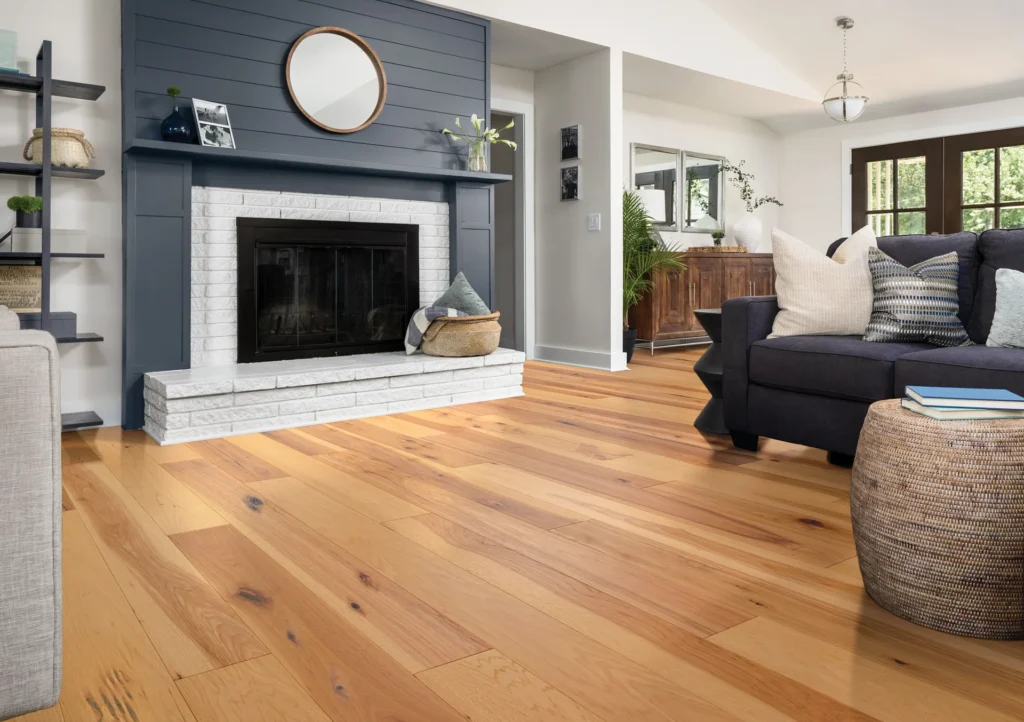

A thicker vinyl plank can feel sturdier, but the biggest millimeter number is not automatically the best purchase. The right thickness has to fit the room, the subfloor, the nearby surfaces, and the product’s locking system. Before paying for extra material, use this guide to decide what those millimeters will actually do in your home.
Plank thickness is measured in millimeters and covers the whole board: the wear layer, printed design, core, and any attached pad. Wear layer thickness is measured in mils and protects the printed surface from wear. Our wear-layer guide explains that top layer in detail; this article stays focused on the full plank.
Start with the useful range, not the largest label
Most vinyl plank sold for homes is roughly 4mm to 8mm thick. Budget and mid-range products often fall around 5mm to 6.5mm, while higher-priced lines commonly reach 8mm or more. Those numbers can help you narrow the shelf, but they cannot grade a floor by themselves.
| Overall thickness | What it may feel like | What to verify |
|---|---|---|
| About 4mm | Lower profile and usually firmer underfoot | Subfloor flatness, joint quality, and whether the room gets light or regular use |
| About 5mm to 6.5mm | A common balance of solid feel and manageable height | Core construction, attached pad, warranty, and transitions |
| About 8mm or more | Heavier and often more cushioned or quiet | Whether the added height creates clearance problems and whether the upgrade benefits this room |
Treat the ranges as a comparison tool, not a pass-or-fail chart. Two products with the same total thickness may use different cores, locking edges, pads, and surface layers. Those details can make them behave differently after installation.
Check these five things before you fall in love with a number
- The core: A rigid, well-made core and strong locking edge matter more than adding a few millimeters to a weak plank.
- The subfloor: Thickness can soften the feel of tiny surface variations, but it cannot bridge dips, humps, loose panels, or a slab that is outside the product’s flatness limit.
- The attached pad: Count it in the total height and check what it is designed to do. A thicker board may simply include a thicker pad rather than a thicker core.
- The finished height: Measure doors, appliances, stair nosing, base trim, and every place where vinyl will meet carpet or tile.
- The written installation guide: It controls the allowed underlayment, subfloor tolerances, expansion space, and warranty—not a general rule from a display card.
What extra thickness can improve
A thicker plank generally feels more substantial when you walk across it. It may add a little cushioning, reduce some hollow sound, and make small texture changes below less noticeable. In a large open room, that firmer feel can be worth paying for. It can also make individual planks easier to handle during installation because they flex less.
There is a limit to that benefit. Thickness does not make vinyl more waterproof; the material and installation details determine how the floor handles moisture. It does not make the top harder to scratch either. For surface durability, compare the wear layer and finish instead of the overall millimeter figure.
Where a few millimeters can create a real problem
Floor height affects more than appearance. A thicker installation may leave a door rubbing, block a dishwasher from sliding out, or require a different reducer where vinyl meets carpet. At a staircase, the new surface has to meet the nosing safely and evenly. Around cabinets and fixed appliances, the order of work can decide whether future service is simple or frustrating.
Map every edge before ordering. Measure the flooring plus its attached pad, any approved separate underlayment, and any leveling material that will remain below it. A clean transition planned before installation looks intentional; a last-minute strip chosen to cover a height surprise rarely does.
Do not stack padding without permission
Many rigid-core manufacturers limit separate underlayment to about 2mm or less, and some do not allow an added layer when the plank already has a pad attached. Too much softness below a click floor lets the joints move under foot traffic. That movement can damage the locking edges and may void the product warranty.
Use the exact installation instructions for the product you buy. If sound control or warmth is the goal, choose a floor system rated for that need instead of building an unapproved stack beneath it.
Match the thickness decision to the room
| Room or condition | What matters first | How thickness fits |
|---|---|---|
| Busy open main level | Stable joints, good core, wear layer, and smooth transitions | A mid-to-thicker plank can add a more settled feel across a large area |
| Kitchen or laundry area | Appliance clearance, waterproof material, and careful edge planning | Choose the height that fits; extra millimeters do not stop water |
| Basement over concrete | Moisture testing and a flat slab | Thickness may improve feel, but it cannot correct moisture or a wavy base |
| Bedroom or quiet office | Comfort, sound, and budget | A modest plank can work well when the base is flat and traffic is light |
| Room beside carpet or tile | The final height at the doorway | Select the plank and transition together before installation starts |
Older South Jersey homes need a flatter floor, not a bigger number
Older houses across Camden, Burlington, and Gloucester Counties can have patched plywood, settled joists, additions, or layers from past remodels. A thick rigid plank may disguise very minor texture, but it will not safely span a low spot. If the floor below moves or falls outside the manufacturer’s flatness rule, preparation is the fix.
Newer construction may have fewer height surprises, yet the same check still applies. A concrete slab can have high spots, and a plywood seam can lift. Inspecting and preparing the base usually protects the finished floor more than moving from 6.5mm to 8mm.
When paying for more millimeters makes sense
Paying more can be reasonable when a thicker option gives you a stronger core, a better locking system, the right attached pad, and a feel you prefer in a room used every day. It is less useful when you are buying thickness alone while ignoring floor preparation or creating awkward height changes.
Keep the whole installed plan in view. The site’s planning range for luxury vinyl plank is $5 to $12 per square foot, and product thickness is only one part of that total. Removal, leveling, trim, stairs, and room shape can matter more to the final quote than two extra millimeters.
The decision in one pass
Choose the room first, inspect the surface below it, measure every meeting point, and then compare complete products. For many homes, a well-built plank in the 5mm to 6.5mm range is a sensible middle choice. An 8mm product may earn its price where a more solid feel, sound control, or a particular construction helps. A thinner plank can still perform well in the right setting when the base is flat and the product is properly installed.
If you want the measurements checked before choosing, a free in-home estimate can turn the product label into a plan for your actual space.
See our luxury vinyl plank choices, then ask us to check your subfloor, clearances, and transitions before you settle on a thickness. Start an in-home visit or call (609) 300-0509.