
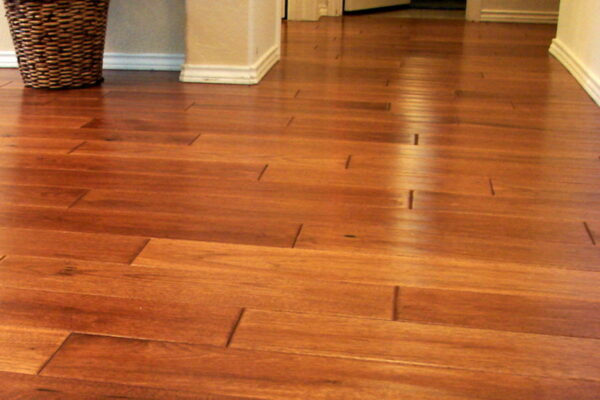

Every January the phone starts ringing with the same call. There are gaps between the boards. There’s a crack running down the hallway. The floor is making a noise it didn’t make in August.
Almost every one of those calls turns out to be normal. Here’s what’s happening under your feet, and the small number of things actually worth doing about it.
Wood never stops breathing
Hardwood is hygroscopic, which is a technical way of saying it absorbs and releases moisture until it matches the air around it. In a South Jersey summer, indoor humidity commonly runs 55 to 65 percent and the boards swell slightly and press together tight. Then the heat comes on in November, and by February indoor humidity in a forced-air house can sit down around 20 to 30 percent. The boards give up that moisture and shrink.
On a twenty-foot run of oak, that seasonal movement can easily add up to an eighth of an inch or more of total gapping, spread across the room. It is not a defect. It is not bad installation. It’s the floor doing exactly what wood does.
Gapping, cupping, and crowning — how to tell them apart
- Gapping: thin openings between boards, worst in late winter, closing up by early summer. Dry air. Normal, and usually seasonal.
- Cupping: board edges sit higher than the centers, so the floor feels like a washboard underfoot. Moisture is coming from below — a damp crawlspace, a slab without a vapor barrier, a slow leak. This one is worth a phone call.
- Crowning: centers higher than edges. Usually means a floor that cupped from moisture was sanded flat before it dried out and stabilized. Preventable, expensive to undo.
Gapping is weather. Cupping is a leak until proven otherwise. If you’ve got cupping in a Medford or Burlington home near the water, check the crawlspace before you call anyone about the floor.
The fifteen-dollar tool
Buy a digital hygrometer. Put it in the room with the floor you care about. Aim to keep indoor relative humidity between 35 and 50 percent year round. That’s it. That single habit prevents more hardwood problems than every specialty cleaner on the shelf combined.
- Whole-house humidifier on the furnace: the real fix if you’re staying in the house. Set it and forget it, but change the pad every season or it stops working and you won’t notice.
- Portable units: they work, but one small unit will not hold a whole open first floor. Size it for the actual square footage and expect to refill it daily in January.
- Wood stoves and pellet stoves: brutal on floors. If you heat with one, humidification isn’t optional.
- Radiant heat under wood: keep the surface temperature under about 80°F and change the thermostat gradually, not in big jumps.
Four things not to do in February
- Don’t fill winter gaps with wood filler. In July those boards swell back and the filler gets crushed out or splits the edges.
- Don’t sand and refinish mid-winter if the house is bone dry. Sanding a shrunken floor flat means uneven boards when it swells back in summer.
- Don’t crank the thermostat to dry things out. You’re making the problem worse.
- Don’t wet-mop. A damp microfiber and a cleaner made for your finish is all a wood floor ever wants, in any season.
Winter salt is the real enemy
Rock salt tracked in from a South Jersey driveway does two things to a finished floor: it scratches like grit, and it leaves a white haze that dulls the finish. A good mat outside, a second mat inside, and a boot tray by the door will do more for your floor’s appearance than anything you buy in a bottle. Felt pads under every chair leg, checked once a year, is the other free win.
If we’re installing wood for you
Acclimation isn’t a scheduling delay we invented. Wood delivered from a cold truck into a heated house needs to sit in that house, in the room it’s going into, until its moisture content matches the environment — usually several days, with the heat running and the house at normal living conditions. Skipping it is the most common cause of floors that gap badly in their first winter. We check moisture content with a meter before we lay a single board, and we’ll show you the reading.
Send us a photo. If it’s normal winter movement we’ll tell you to buy a humidifier and save your money. If it’s cupping, you want to know now rather than in April. J&J Flooring, (609) 300-0509, serving Camden, Burlington, and Gloucester counties.