
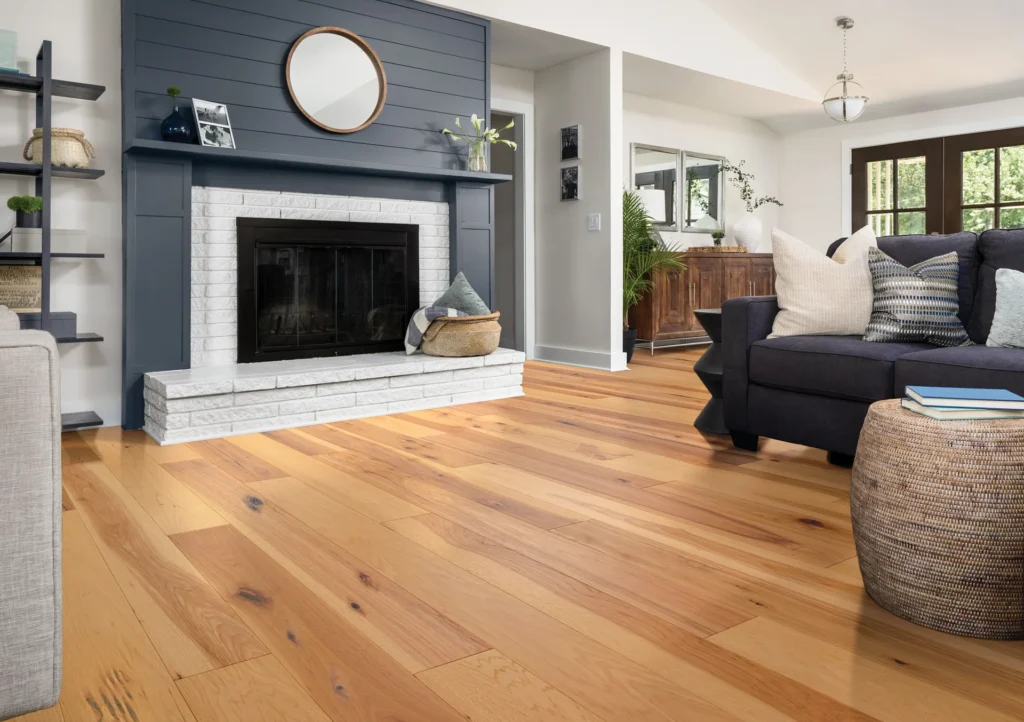

Short answer: yes, you can put luxury vinyl plank in a basement — and for most homes it is the best floor you can put down there. It is waterproof, it installs right over concrete, and it looks like real wood in a room that usually gets the least natural light in the house. But there is one test you need to run first, because even a waterproof floor can fail over a wet slab.
Why vinyl plank works so well below grade
A basement floor has three enemies: moisture coming up through the concrete, the occasional spill or leak, and a slab that is never perfectly flat. Luxury vinyl plank handles all three. The plank itself is waterproof — not water-resistant, waterproof — so a wet season or a spilled drink cannot swell it. It floats over the slab with a click-lock system, so there is no glue to fail. And its rigid core bridges the small dips and bumps that every concrete floor has.
The one test to run first: moisture
Here is the part most people skip. Concrete always carries some moisture, even when it looks bone dry. Tape a two-foot square of plastic sheeting flat to the slab, seal all four edges, and leave it for 24 to 48 hours. If you peel it up and see condensation or a darkened patch of concrete, the slab is pushing moisture up — and that moisture has to be handled before any floor goes down. A dehumidifier solves mild cases. A moisture barrier under the floor handles the rest. Skip this step and the floor can grow musty odors or lift at the edges within a year, waterproof or not.
What to look for in a basement vinyl plank
- A rigid core (SPC or WPC). Flexible glue-down vinyl telegraphs every crack and bump in the slab; a rigid core floats over them.
- A wear layer of at least 12 mil for a family room, 20 mil if the basement is the kids' main play space.
- An attached underlayment pad. It adds warmth and quiet over cold concrete — the difference between a floor that feels like a basement and one that feels like a room.
- A click-lock system, not glue-down. If a pipe ever leaks, click-lock planks can be pulled up, dried, and put back. Glued planks cannot.
How it compares to the other basement options
| Floor | Handles moisture? | Feel underfoot | Verdict |
|---|---|---|---|
| Luxury vinyl plank | Yes — waterproof | Warm with an attached pad | The best choice for most basements |
| Carpet tiles | With a moisture barrier | Softest and warmest | Good for dry, finished family rooms |
| Solid hardwood | No — warps | — | Never below grade |
Cold floors and comfort
The one honest knock on vinyl plank in a basement is that it sits on cold concrete. The fix is simple: choose a plank with an attached pad, or add a thin underlayment rated for vinyl. It takes the chill off, softens footsteps, and quiets the room. If the basement is going to be a cozy TV room and you want true softness, low-pile carpet tiles over a moisture barrier are the one carpet option we are comfortable putting downstairs.
The order that works
Test the slab, fix the moisture, then pick the plank. Do it in that order and a vinyl plank basement floor will outlast almost anything else in the house. Our full guide to flooring for South Jersey basements walks through the moisture side in more detail, and when you are ready, we bring the samples down to your basement so you can see them in the actual light the room gets.
We test the slab, bring the samples to your home, and quote the finished job installed. Call (609) 300-0509 or request your free estimate online in about a minute.