
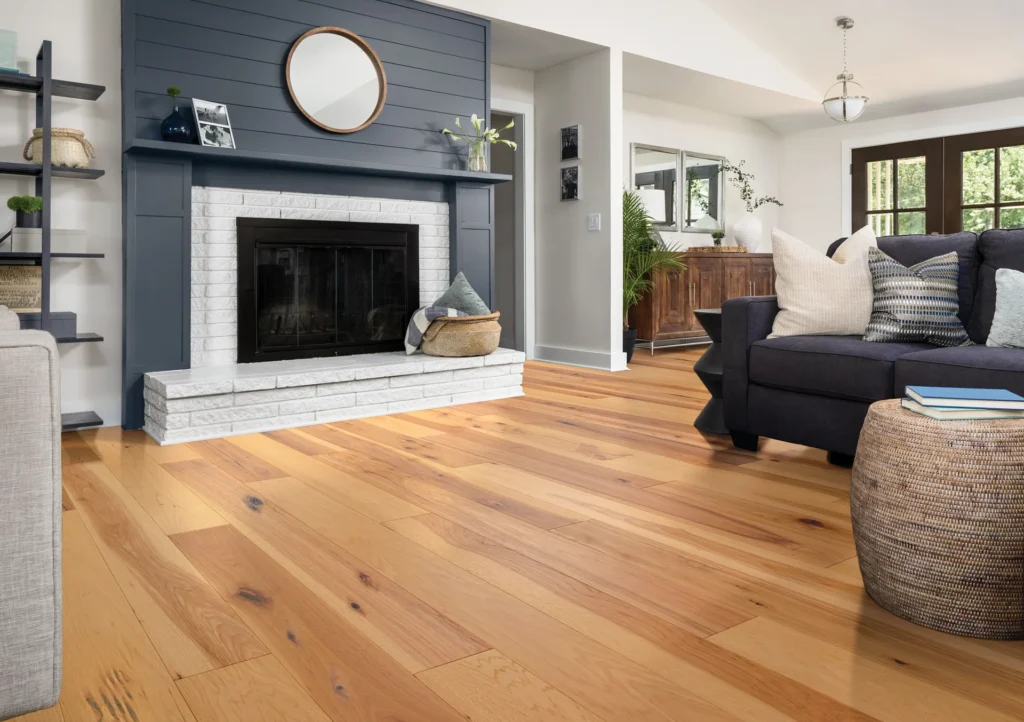

Tearing out old tile is loud, dusty, slow work. So when a dated kitchen or entry floor is still stuck down tight, it is fair to ask whether new vinyl plank can just go on top. Often it can. The catch is that the tile becomes the base for your new floor, and any flaw it has can show through later. This guide is built as an inspection you can do yourself before anyone quotes the job.
Yes, in many homes. The tile must be firmly bonded, flat, and clean, and the plank maker must allow it. Loose, hollow, or cracked tile gets fixed or removed first.
The 10-minute floor walk
Grab a broom handle or screwdriver, a long level or straight board, a flashlight, and a coin. Then go room by room.
- Minute 1 to 3, listen for hollow spots: lightly tap each tile with the handle. A solid click is good. A dull, drum-like sound means the tile may have lost its bond.
- Minute 3 to 5, look for cracks: shine the flashlight low across the floor. Cracks that run across several tiles can point to movement underneath.
- Minute 5 to 7, check flatness: lay the straight board in several directions. Note any gap under it, or any spot where it rocks on a high point.
- Minute 7 to 8, check the grout: slide the coin edge across the joints. Deep, wide, or crumbling grout lines are worth writing down.
- Minute 8 to 9, check the edges: look at doorways, the dishwasher, the fridge space, and any toilet. These are where extra height causes trouble.
- Minute 9 to 10, think about moisture: is this tile on a ground-level slab, near an outside door, or in a room that has had leaks?
Write down what you find. It makes the visit with an installer much faster and keeps the conversation focused on your actual floor.
Why grout lines matter most
Grout joints are low spots in an otherwise hard surface. Thin or soft vinyl can slowly settle into them, and over time a faint grid can appear on top of your new floor. Installers call this telegraphing.
Rigid-core planks, such as SPC, are stiffer and span those joints much better than flexible products. Even so, wide or deep joints should be filled and smoothed with a patching or leveling compound, or covered with an underlayment the plank maker approves. Each brand sets its own limit for how much unevenness is acceptable, so follow the instructions for the exact plank you pick rather than a general rule.
Floating or glued: which method suits tile
Most vinyl plank laid over tile is a floating click-lock floor. The planks lock to each other, not to the tile, so small imperfections are more forgiving. It is also easier to pull up later if you change your mind.
Glue-down vinyl is thinner and follows every bump under it. Over tile it needs a very smooth, skim-coated surface, or the joints and edges tend to show. For most homeowners keeping their tile, floating rigid-core plank is the simpler path.
Keep, skim and cover, or remove?
| What your floor walk found | Likely decision | Why |
|---|---|---|
| Solid sound, flat, narrow shallow grout | Keep the tile and float plank over it | A sound, even base is what the plank needs |
| Solid sound, but wide or deep grout | Skim the joints, then cover | Filling the joints prevents a grid showing through |
| A few hollow or cracked tiles | Repair those spots, then cover | Loose pieces can shift and move the floor above |
| Many hollow tiles or widespread cracks | Remove the tile | The base is failing and patching will not hold |
| High spots, dips, or a rocking board | Level first, or remove if severe | Rigid planks need a flat surface to lock well |
| Height will not clear doors or appliances | Often remove | Taking tile out solves the clearance problem |
Room-by-room notes
Kitchens: the dishwasher is the spot to check first. If the new floor runs under it, the opening can get tighter and make the unit hard to pull out later. Many installers stop the plank at the cabinet base for this reason, but measure before deciding.
Bathrooms: added height changes how the toilet sits on its flange. That can be handled, but it is part of the job, not an afterthought. Small baths also have more edges, a tub, and a door in a short space, so every transition counts.
Entryways: front doors often swing close to the floor. A few extra millimeters can make a door scrape, and a raised threshold here is a trip point. Check the swing before you commit.
Ground-level slabs: tile on concrete can hide moisture coming up from below. Vinyl plank resists water on top, but it does not fix a damp slab. If the room ever smells musty or has had water, have the moisture checked first.
The height question, measured honestly
Every layer you keep adds up: the tile, its mortar, any skim coat, and the new plank. Height matters where the new floor meets another room, at door bottoms, under appliances, along stair edges, and at baseboards. A transition strip can bridge a small step, but a tall one can look awkward and catch toes. Measure these spots during your floor walk instead of finding them on install day.
When removal is really the better choice
Keeping tile saves demolition, but it is not free. Filling joints, fixing loose pieces, leveling, trimming doors, and adjusting a toilet each take time. If your floor walk turned up several of those, removal can end up close in effort and give a cleaner, lower result. Removal also makes sense when you want the new floor to sit even with a nearby room.
There is no fixed answer on which costs more. It depends on the square footage, how the tile was set, and how much prep the surface needs. A written quote that lists both options side by side is the fair way to compare.
Questions to bring to your installer
- Does the plank I like allow installation over existing tile, and what does its warranty require?
- Will you skim the grout joints, and with what product?
- How will you handle the hollow or cracked tiles I found?
- What will the finished height be at each doorway and next to each nearby floor?
- Will the dishwasher, fridge, and doors still clear?
- If this is a bathroom, how will the toilet be reset?
- Can you price both keeping the tile and removing it?
Read the plank maker installation instructions and warranty terms before buying. Many brands spell out what existing floors they accept and how to prepare them, and skipping those steps can affect coverage.
Bottom line
Sound, flat tile is often a perfectly good base for a floating vinyl plank floor. Loose tile, failing grout, damp slabs, and tight clearances are the signs to slow down. You can compare rigid-core styles on our vinyl plank flooring page before you decide.
Book a free in-home flooring estimate and we will look at your floor, measure the height points, and walk you through your options. Prefer to talk? Call (609) 300-0509.