
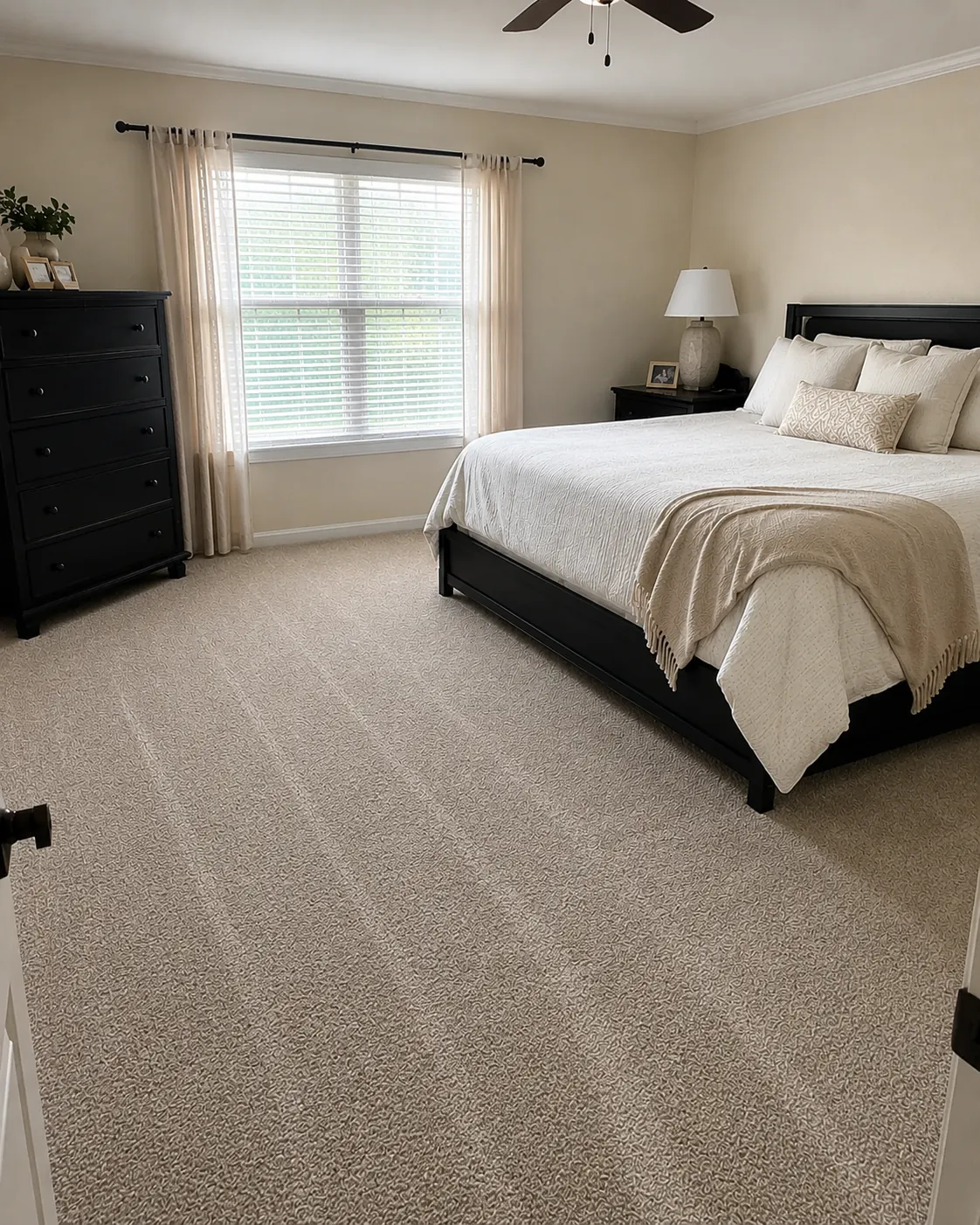

Late afternoon sun pours through the living room slider, and there it is: a faint straight line across your new carpet. In the morning you could not find it. By dinner it looks like a road.
That line is a seam, the spot where two pieces of carpet were joined. Here is the honest truth up front. A good seam can be hard to spot, but it is almost never truly invisible. The best results come from choices made before the carpet is cut, so this guide starts there.
Step 1: Ask for the seam map before you order
Carpet comes off a roll with a set width. When a room is wider than the roll, two pieces must meet. Where they meet is a choice, and it is made on paper at the layout stage. Our walk-through on how to measure for carpet shows why roll width creates seams in the first place.
So ask for a simple sketch of the room that shows each seam line. You do not need a fancy drawing. A hand sketch with arrows is enough. Then ask these questions while changes are still easy:
- Where does each seam fall compared to the windows and the slider?
- Does any seam cross a doorway or the main path people walk?
- Can a seam sit under the sofa, a bed, or a dresser instead?
- Which way will the pile lean in each piece?
- Is there a layout with fewer seams, and what does it change?
Sometimes the room shape leaves only one good choice. That is fine. The point is to know where the line will be before install day, not to discover it after.
Step 2: Understand light and pile direction
Carpet fibers lean a little, like grass after a mower passes. That lean is called pile or nap direction. When both pieces lean the same way, light bounces off them the same way. When one piece is turned, it reflects light differently, and the seam shows even if it is glued down tight.
Light is the other half of the story. A seam that runs across a big window or sliding door catches low sun from the side, and every tiny ridge throws a shadow. A seam that runs toward the window, or sits away from strong light, tends to blend in much better.
Try this before you sign off on a style. Lay the sample on the floor where the seam will go. Look at it in the morning, at midday, and with lamps on at night. Turn the sample around and look again. You will see how much light and direction change the color.
Step 3: Pick a style that forgives a join
Some carpets hide a seam better than others. In general, textured cut-pile styles mask a join well because the surface is already a little uneven. Loop and Berber styles are tougher, since a row of loops can show a clear break. Patterned carpet is the hardest, because the pattern has to line up across the join. You can compare textures on our carpet collections page.
Step 4: Know what good seaming looks like
You do not need to do the work, but it helps to know the basics. The edges should be cut clean and straight so the two pieces butt together without a gap. The standard method uses heat-activated seam tape under the join, warmed with a real seaming iron. A household clothes iron is not a tool for this job and can scorch the fibers.
Rushing the heat can leave a weak bond that lets go later. Some synthetic fibers call for a cold-applied adhesive instead of heat, so the carpet maker's instructions set the method. Afterward, the installer usually brushes the fibers across the line and trims any stray tufts so the two sides blend.
Tension matters too. Carpet that is not stretched enough can let a seam pull open or rise into a peak over time. If you are also seeing ripples away from the seam, our guide to carpet wrinkles after installation covers that separate problem.
Cosmetic or needs repair? A quick table
| What you see | Usually | What to do |
|---|---|---|
| A faint line only in side light | Normal for most seams | Brush the pile across it; move a lamp or rug if it bugs you |
| One side looks a shade lighter or darker | Pile direction or light angle | Check it at different times of day before calling |
| A few loose fibers along the line | Normal settling | Snip them level with scissors; never pull |
| The seam is opening into a gap | Bond or tension problem | Call the installer |
| The seam rises into a ridge or peak | Often stretching or subfloor | Call the installer; a surface fix will not hold |
| Backing or tape is showing | Failed seam | Call the installer soon |
What to photograph before you call
Take a wide photo that shows the whole seam and the window near it. Then take close shots of any gap, peak, or fraying. Write the date and the time of day, since light changes the look. If the problem grows, take new photos a week later. A clear record makes the service call quicker and helps anyone judge whether it is a real defect or just light.
Living with a seam you can see
If the seam is sound but still catches your eye, small moves help. Shift a reading lamp so light falls along the seam instead of across it. Angle a chair or set a runner so the line is broken up. Follow the carpet maker's care guidance when vacuuming near a seam, and avoid pulling on loose fibers.
Get a free in-home estimate to talk through your rooms and your questions about seams, or call (609) 300-0509.