
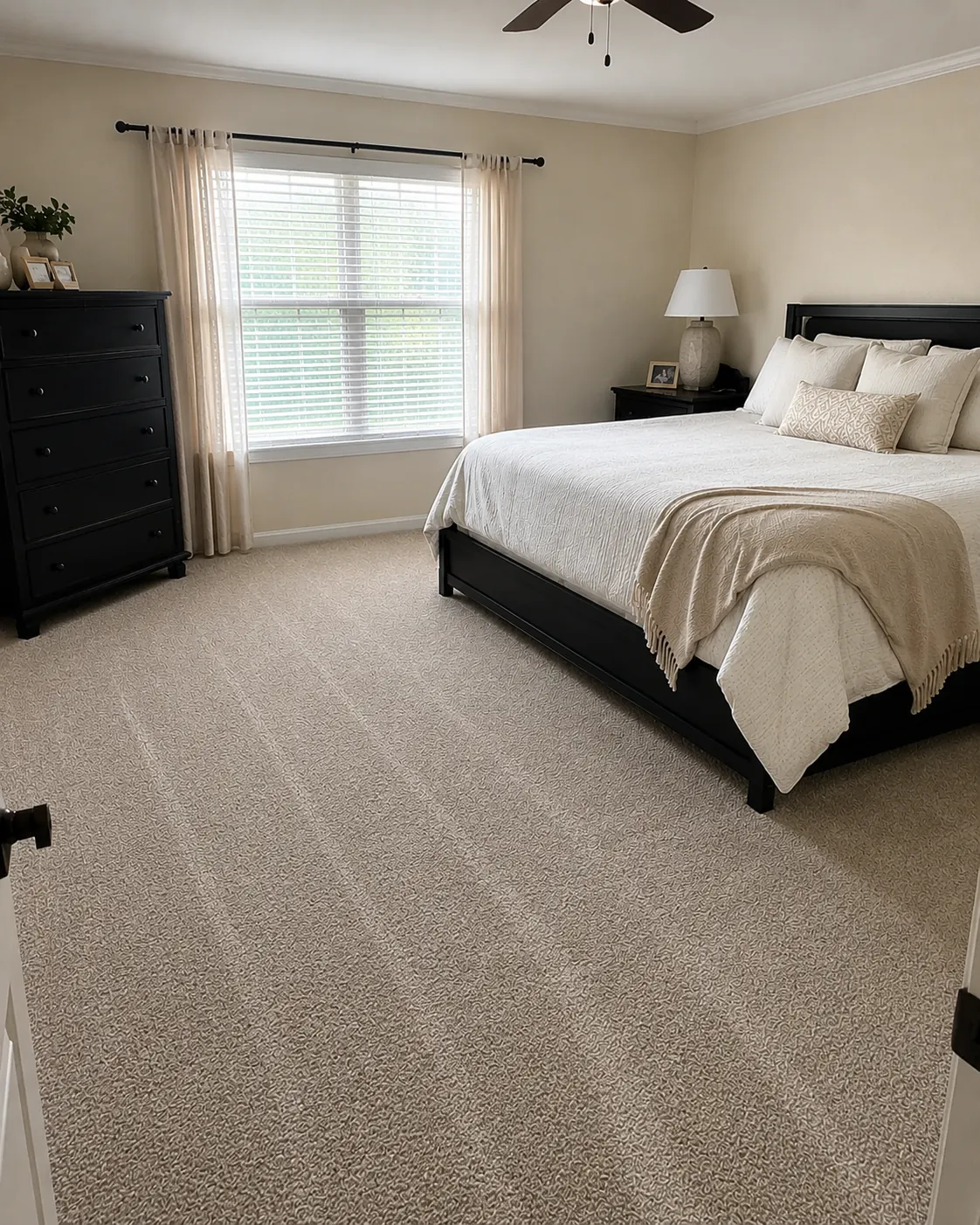

Pull the desk chair back as if you were getting up for coffee. That sweep across the floor is the part of a home office worth planning first. A quiet room can put repeated wear on a small patch, even when few people walk through it.
Carpet for a home office can work, but the chair, wheels, mat, and carpet must suit one another. Low, dense pile is generally a better starting point than deep plush. A suitable chair mat may also be required by the carpet’s written terms. Neither a tough-looking sample nor new wheels make direct rolling harmless.
Map the space the chair actually uses
Picture the desk in its final spot before choosing the floor. Mark the arc behind it, the place the chair rests while you work, and the route to the door. Include the reach to a filing drawer or second screen. That is the chair zone, not just the square directly beneath the seat.
Now imagine the rest of the room furnished. Can you roll back without reaching a mat edge? Does a cabinet force the chair sideways? A corner or L-shaped desk may need a broader mat to cover those moves. Leave space for the way you sit and stand, not just the desk’s footprint.
Keep cords and any floor outlet in the planning conversation. They should not sit where wheels travel or make a mat rock. An outlet position may need a qualified person’s advice. Decide the desk location early so the carpet layout and chair protection follow the same room plan.
Choose the carpet outside the mat as well
Short, dense pile and tighter construction generally cope with chair use better than tall, soft plush. The carpet beyond the mat still takes feet, chair-edge contact, and the route to the doorway. Look for a surface that suits those habits rather than selecting softness alone.
Low pile is not the same as permission to roll without protection. Cut pile and loop construction both need a product-use check. Our cut-pile and loop room guide compares those surfaces; for this office, ask how the exact carpet handles the chair use you have described.
Coffee at the desk makes stain resistance worth discussing too. That does not mean every spill is covered or easy to remove. Fiber is only part of the choice: the nylon-and-polyester comparison explains those trade-offs without making one fiber the answer to every office.
Set up the wheels, then the mat beneath them
Inspect the casters already on the chair. Many chairs arrive with one wheel type regardless of the floor. Hard nylon casters are the usual match for carpet. Soft polyurethane casters are generally intended for hard floors or the hard surface of a chair mat. Too-soft wheels rolling directly on carpet can drag and collect fibers.
Match the wheels to the surface they will actually touch and check the chair maker’s compatibility guidance. Do not choose hard wheels for carpet, then forget that most movement will happen on a hard mat. Replacing casters does not cancel the carpet’s rolling-use limits or remove a mat requirement.
Next, select a mat made for carpet and the depth beneath it. Carpet mats commonly have grippers or cleats underneath and are sold for different pile depths. The carpet-plus-cushion depth matters to support. A mat meant for a shallower assembly can flex or sink instead of giving a stable rolling surface.
Finally, choose coverage for the mapped chair zone. A lipped mat extends under the desk edge so the chair does not drop onto bare carpet when you move forward. Check the full backward and sideways travel too. The right depth with the wrong shape still leaves wheels running over an exposed strip.
Plan seams before the desk makes them hard to reach
Tell the estimator where the chair zone will be and ask whether a seam can be kept out of it. Room shape and the chosen carpet may limit the options, so treat this as a layout question, not a promise of a seamless room. Our carpet seam-planning article explains the wider seam map.
Discuss the cushion along with the mat selection. Extra softness beneath carpet is not automatically helpful under a rolling chair. The cushion must meet the carpet maker’s specification; the carpet padding selection guide covers that separate choice. Keep the selected carpet and cushion details available when shopping for the mat.
Read the exact carpet’s warranty and care instructions for caster damage and chair protection. Rolling-chair damage is commonly excluded, and some terms specifically require a chair mat. Our carpet warranty document guide explains conditions and exclusions. A mat protects a working area; it is not proof that every future chair mark will qualify for coverage.
If the chair patch is already flat or fuzzy
A compressed patch under the chair and loose fuzz are different clues. Flattening can reflect repeated pressure; fuzz may involve loose fibers or wear. Look at where it occurs, whether wheels have gathered yarn, and whether the surface differs outside the rolling path. Do not assume more vacuuming will repair damaged pile.
For a dent, use the carpet furniture-dent article rather than trying a home remedy on the whole chair zone.
For loose fiber, the new-carpet shedding guide helps separate common shedding from signs that need attention. Neither guide promises to rebuild worn fibers. Stop direct rolling over the damaged area and get advice if yarn is snagging or the patch is worsening.
An office that may be better without carpet
If the chair travels all day across a broad area and you do not want a mat covering that path, carpet may be the wrong fit. The same is true if deep plush is essential but the mat setup feels unstable or awkward. Choose the room’s working needs over a sample that only feels good under a bare foot.
Consider vinyl plank options for a rolling-chair office as a different starting point, not a damage-proof alternative. Hard floors still need suitable wheels, chair protection where required, and a check of the product’s rolling-use rules. Keep the choice focused on whether the protection and maintenance suit your daily work.
Compare carpet choices for your workspace with the chair zone already mapped, so the sample choice fits the room you will work in.
Take your chair-zone sketch to a free in-home estimate for the office, or call (609) 300-0509. Bring the desk position, mat coverage, and doorway route into the discussion.