
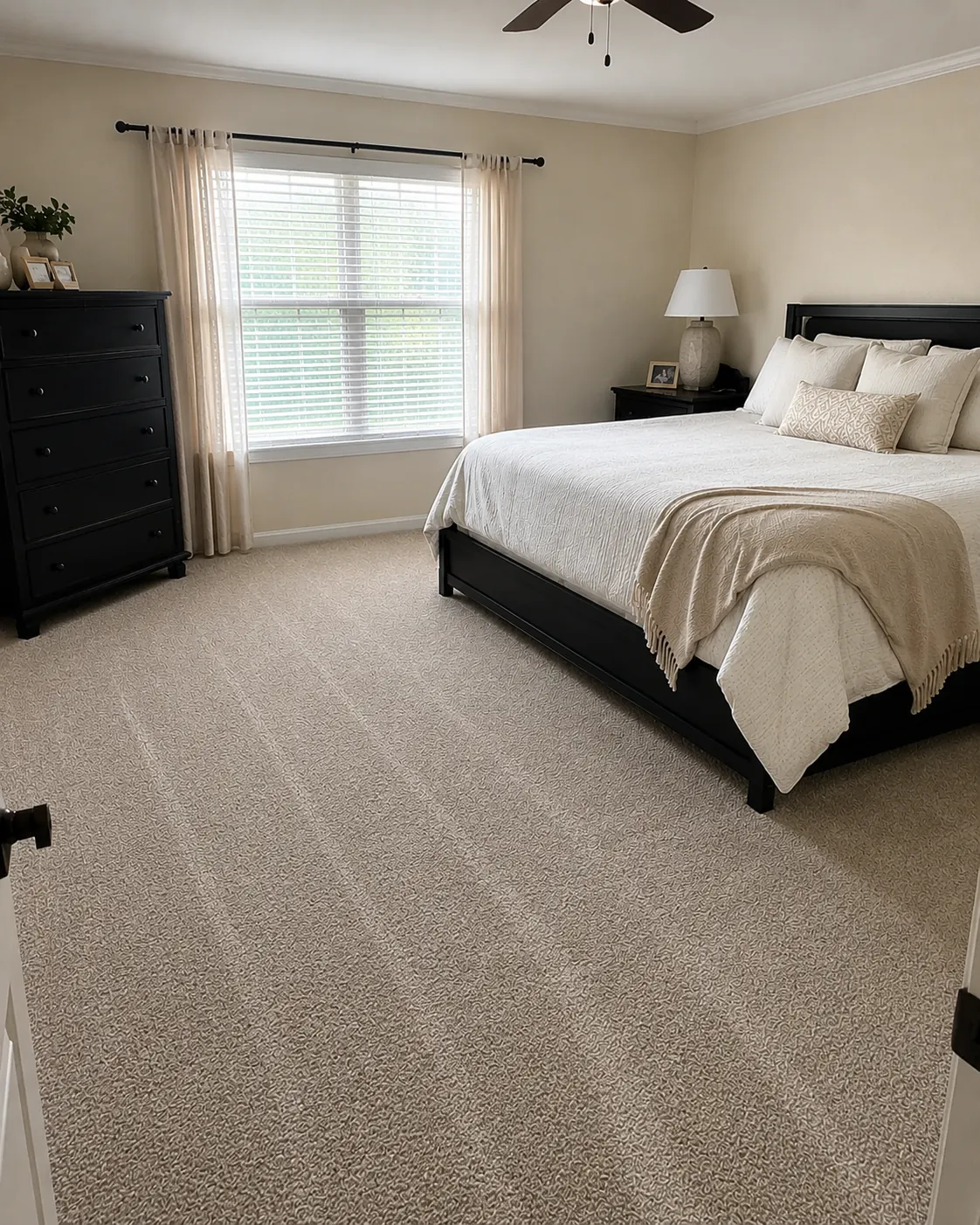

Picture a bedroom door. On one side is new vinyl plank. On the other side is soft carpet. The thin strip where they meet is small, but you will step on it every day. You will see it every time the door is open.
An LVP to carpet transition is the piece that covers that meeting line. Picking it is easier when you stand in the real doorway instead of guessing from a catalog. This guide walks you through it in four stops: look, feel, pick, then check after the floor goes in.
There are no prices here. Transition pieces belong on your written estimate, next to the floors they join.
Stop one: look at where the line will fall
Open the door halfway and stand in the opening. Most people want the change from plank to carpet to sit right under the door when it is closed. That way, each room looks finished on its own side. From the hall you see only plank. From the bedroom you see only carpet.
If the line sits a little too far toward one room, you may see a sliver of the other floor peeking out under a closed door. It is not a big flaw, but it is easy to avoid when it is decided early.
- Close the door and look from the hall side. Where does the bottom edge of the door land?
- Now go inside the room and look again from that side.
- Note any door stop, wall corner or trim that could get in the way of a straight line.
Stop two: feel the height difference
Carpet sits on a pad. Together they usually end up a bit higher than vinyl plank. So the join is often a small step, not a perfectly level line. How big that step feels depends on the plank, the carpet and the pad you choose.
If old carpet is still in the room, press it down with your hand near the doorway. Feel how much it squishes. Compressed carpet is closer to its real walking height than fluffy carpet is. Then think about the new plank on the other side. Our luxury vinyl plank thickness guide explains why the plank's build changes the final height at a doorway.
You do not need a ruler for this stop. You just need a rough sense of it: is this going to be a clear step, or close to even?
Stop three: pick the piece that fits
Here are the common choices in plain words. Your installer will confirm the right one once the products are chosen.
| Your doorway | Likely piece | How it feels underfoot | Watch out for |
|---|---|---|---|
| Carpet will sit clearly higher than the plank | A sloped reducer | A gentle ramp instead of a sharp edge | Choose a color that will not stand out against the plank |
| Pressed-down carpet sits close to the plank height | A metal carpet edge (often called a Z-bar) or a gripper-style edge | Nearly flush; the carpet tucks tight to the plank | The carpet must be cut and tucked neatly, or the edge can show |
| Both sides end up close to the same height | A T-shaped molding | A slim strip with a small cap on top | A cap that sits proud can catch toes, paws or a vacuum |
| Only one room is getting new floor | Whatever matches the old floor's height | Depends on the fixed side | The old floor cannot move, so it decides the piece |
Some carpet-edge pieces have a lip that grips the cut edge of the carpet. That lip helps keep the edge from fraying and coming apart over time, which matters most in a doorway that gets walked through all day.
Click-together vinyl plank floats. It needs a small expansion space at doorways. The transition covers that space without pinning the planks down. How wide the gap is, and whether a piece may be fastened through the floor, comes from the plank maker's installation guide.
If a few planks ever start to pull apart near a doorway, a pinned edge is one thing to look at. Our post on why vinyl planks pull apart covers the other usual causes.
Pick a color and finish
You have three easy paths. Match the plank so the piece fades into the floor. Match the door trim so it looks like part of the frame. Or pick a metal finish that reads as a clean, thin line.
Look at a sample of the piece in daylight and again with the room lights on. A shiny metal strip can look bright in photos. A wood-look strip that is close but not quite right can look more off than a plain one. When in doubt, hold the sample right next to the plank on the floor, not up in the air.
Think about the door, pets and the vacuum
New floors can raise the height under a door. Swing the door open and closed and watch the bottom edge. If it already brushes the old carpet, it may rub the new floor too. A door that needs trimming is a normal part of some jobs. It is better to know at the estimate than on install day.
- Does your dog or cat skid or catch claws at doorways? A smooth, low edge is kinder to paws.
- Does your vacuum bump hard when it crosses into the bedroom? A raised carpet edge or tall cap can catch it.
- Do kids run through this door? Ask for the lowest, smoothest option that fits the height.
Settle it before install day
This choice is not a finishing touch you add at the end. It changes the order the floors go in. It also changes how the carpet gets cut at the door. If the plank goes in first, the carpet installer needs to know which edge to tuck against. If the carpet is staying, the plank has to end at a height and line that suits it.
The "only one room" case needs extra care. Say you are putting vinyl plank in a hallway but keeping the bedroom carpet. The bedroom side is fixed. Its height decides the piece, and the plank has to meet it. If you plan to replace that carpet soon, say so. It may change what makes sense now.
You can see our carpet styles for the room next door if you are thinking about both.
Doorways are also a good time to think about other edges in the house. Our guide to putting LVP over tile talks about height where tile is staying.
Lines show up in carpet too. The carpet seam guide covers how they read in different light.
Stop four: check the doorway at the walk-through
When the floors are done, walk the doorway with your installer. Use bare feet or socks if you can. A good doorway feels like this:
- The piece sits flat and does not rock or click when you step on it.
- The carpet edge is tucked tight with no loose threads or gaps.
- The line is straight and lands where you planned under the closed door.
- The door swings freely without rubbing.
- The color looks the way you expected in your own light.
If something is off, point it out right then while everyone is there. Small fixes are simplest before tools are packed.
Questions to bring to your estimate
- Which piece do you suggest for each doorway, and why?
- Where will the line fall under each door?
- Which floor goes in first?
- Will any doors need trimming?
- What finish choices do I have for the transition?
- Does the plank maker allow fastening at this spot, or does the piece need to float?
- Is each transition listed on my written estimate?
Get a free in-home estimate and we will bring samples and look at each doorway with you, or call (609) 300-0509.