
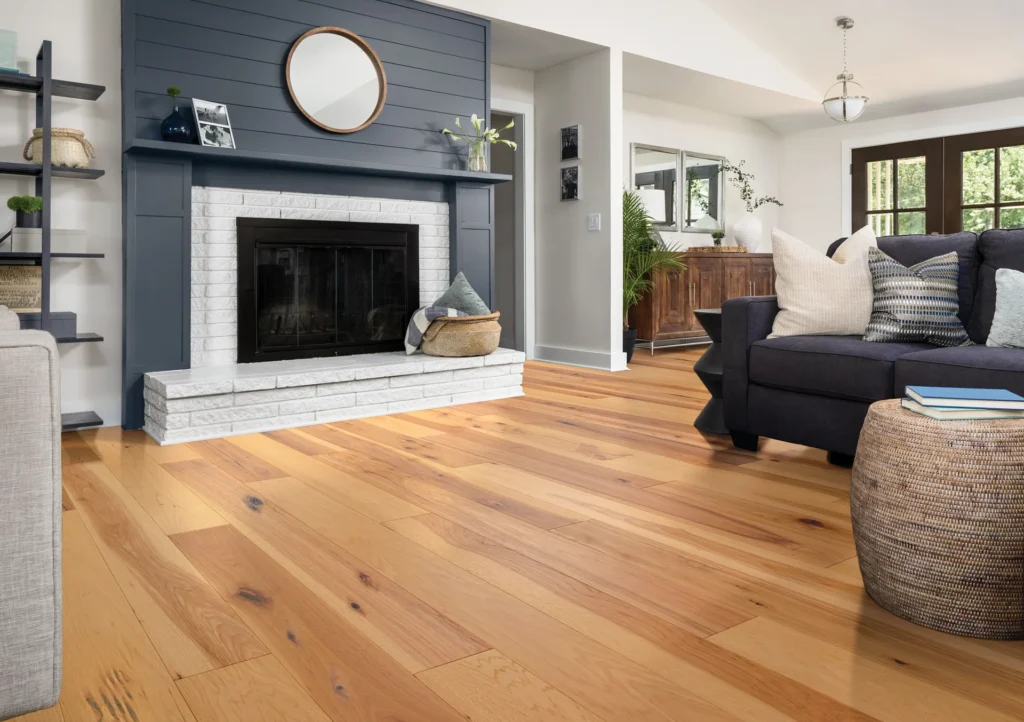

A thin dark line shows up between two planks in the hallway. Then you spot another by the slider door. Vinyl plank is supposed to lock tight, so a gap feels like a sign something went wrong. Sometimes it did. Often, though, the floor is simply reacting to the room around it, and the line closes again on its own.
Below are the five causes that come up again and again, a table for reading what your gap is telling you, a short list of moves that make things worse, and a fix ladder that starts with the cheapest step.
Reason 1: The seasons push and pull the floor
Vinyl plank grows a little when it gets warm and shrinks a little when it cools. Humidity plays a part too, especially with cores that are not fully rigid. In South Jersey, a home runs dry with the heat on all winter, then sits in sticky air through July and August. A floor that looked perfect in June can show hairline lines in February.
The tell is timing. Gaps that appear in one season and fade in the next, spread fairly evenly across the room, are usually movement and not damage.
Reason 2: The floor has no room to move at the walls
A floating floor rests on the subfloor instead of being glued down. It needs a small open space around every wall, cabinet run, pipe, and door frame, hidden under trim. When that space is missing or too narrow, the floor pushes against a wall as it grows. With nowhere to go, the joints can pull apart elsewhere, or the planks can peak and lift.
Heavy items can cause the same trouble. A kitchen island set on top of a floating floor, or trim nailed down through the planks, pins the floor in place. The rest of the room keeps moving, and the strain shows up as gaps near the pinned spot.
Reason 3: The subfloor is not flat enough
Click joints hold best on a flat base. Over a dip or a hump, a plank flexes each time someone steps on it. Over months, that flexing can work the locking edge loose. These gaps often come with a soft or bouncy feel in the same area. Each product sets its own flatness limit, so the installation guide in the box is the rulebook, not a general number.
Reason 4: The planks were never fully set
Two things during install can leave a floor ready to open up later. First, joints that were not tapped fully home. A click joint can look closed and still sit a hair short of locked, then slowly creep open. Second, planks that went down before they settled to the room. Many makers ask for planks to rest in the space for a set time before install, at the temperature listed in their guide.
Glue-down vinyl has its own version of this. If the planks or the room were much colder or hotter than the guide allows when the adhesive went down, the planks can shrink or grow once the room returns to normal. A damp slab can also weaken the bond, letting pieces drift.
Reason 5: Now and then, it is the product
Less often, the plank itself is the problem: a locking edge that was milled poorly, or a batch with sizing that is a little off. You usually see this as gaps along the same edge of many planks, even in a stable room on a flat floor. This is the case where the warranty matters most, so it is worth reading before anyone starts pulling up rows.
Read the pattern before you pick a fix
Where and when the gap shows up narrows down the cause fast. Use this as a starting point, not a final answer.
| What the gap looks like | Likely cause | First step |
|---|---|---|
| Thin lines all over the room, mostly in winter | Seasonal shrinking in dry heated air | Watch it through a full season and keep indoor conditions steady |
| Gaps grouped near a sunny window or slider | Heat from sunlight swelling and shrinking planks | Use shades during the hottest hours and recheck |
| Gaps on one side of the room plus a lifted or peaked seam | Floor pressing against a wall, cabinet, or pinned trim | Have the perimeter space checked under the trim |
| One or two gaps over a soft or bouncy spot | Dip or hump in the subfloor | Plan to lift the area and flatten the base |
| Gaps near a heat vent or radiator | Local heat drying and shrinking the planks | Redirect airflow and watch for change |
| The same edge open on many planks in a stable room | Possible locking or sizing defect | Document it and contact the installer and maker |
| Pieces drifting on a glue-down floor | Adhesive weakened by moisture or wrong install temperature | Call the installer; the slab may need testing |
Take photos before anything else
Before you try a fix, start a simple record. Take a photo of each gap with a coin or ruler next to it for scale. Write the date, the room temperature if you have a thermostat reading, and whether the heat or air was running. Repeat every few weeks.
This does two jobs. It shows whether the gaps come and go with the seasons, which often answers the question by itself. And if you end up making a warranty claim, dated photos help show what happened. Many warranties also spell out install and care conditions, and some can be affected by repairs done outside their terms, so read yours first.
Three things that make gaps worse
- Screwing or nailing through floating planks. It may close one gap, but it pins the floor and pushes the movement somewhere else, often into a bigger problem.
- Gluing a floating floor at the joints or to the subfloor. Floating systems are built to move as one sheet. Glue fights that design.
- Forcing planks tight with heavy blows. Pounding on a click edge without the right block can crack the lock, and a broken lock will not hold.
The fix ladder, from simplest to biggest
Start at the top and only move down when the step above does not solve it.
- Wait and steady the room. If the pattern points to seasons, give it a full cycle. Keeping the home at a steady temperature and moderate humidity is often all a floating floor needs.
- Close small gaps in place. On click floors, a pro can sometimes nudge a few planks back together with a floor pull bar or a tapping block and gentle force. This works best on a handful of localized gaps.
- Fix what is pinning the floor. Trim should attach to the wall or subfloor, never to the planks. Freeing pinned trim and restoring the open space at the walls removes the pressure behind many gaps.
- Unlock and reset the affected rows. An installer can take the floor apart back to the problem area, then relay the rows so every joint is fully locked.
- Flatten the subfloor. If a dip or hump is behind the trouble, the planks over it come up, the base gets leveled, and the floor goes back down.
- Replace damaged planks. Pieces with chipped or cracked edges will not lock again and need to be swapped out.
Colored filler can hide a line for a while. It is a short-term cosmetic patch. It does not fix the cause, and it can crack or pop out when the floor moves again.
When is it time to call the installer?
Call when gaps keep growing after a full season, when they show up across several rooms, when planks are shifting or lifting, or when you suspect a defect. Those are signs of a cause that patience will not solve. Have your photos, notes, and the product name ready. If the floor is fairly new, the installer may want to see it before you contact the maker.
If the floor below a basement or slab room is part of the story, our guide to luxury vinyl plank in a basement covers moisture and subfloor questions in more detail.
Planning a new floor and want to avoid this from the start? Browse our vinyl plank collections to compare options.
Seeing gaps now and not sure which reason fits? Get a free in-home estimate, or call (609) 300-0509.